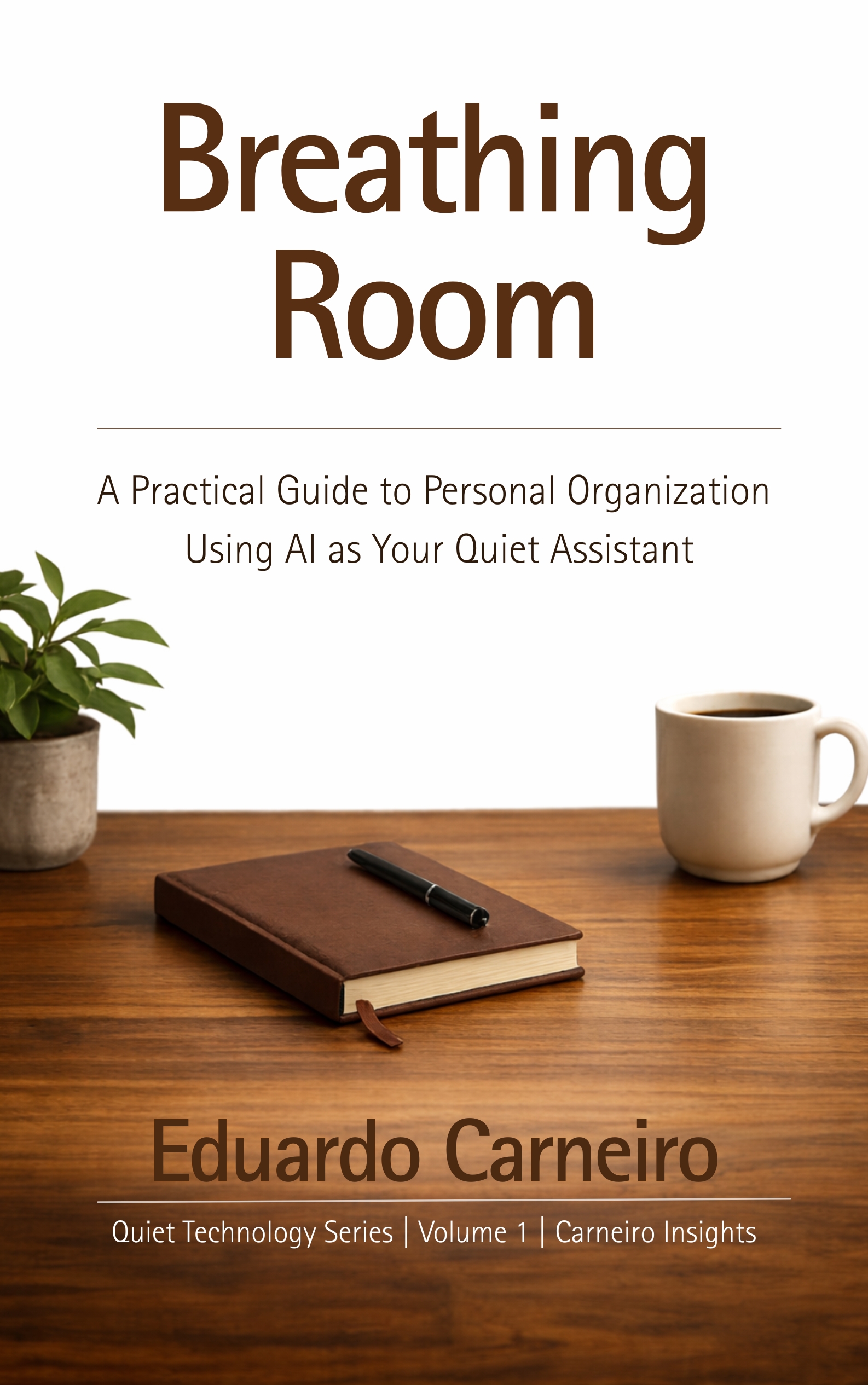
A Book by Eduardo Carneiro

The 90 Percent of AI Users Are Leaving Results on the Table

Most professionals use AI like a search engine.The difference isn't the model. It's the mental model.This book gives you that mental model.

Scroll to discover
Beyond the Prompt - Prompt Engineering for Real Results with Artificial Intelligence by Eduardo Carneiro
01The Reality

You're not using AI wrong.
You're typing into the void.

It's 10:15 AM. You've just asked the AI to write a market analysis for your team. The response arrives in seconds.It's technically correct. And completely useless.

Three generic paragraphs about trends you already knew. Nothing you couldn't have written yourself—and this was supposed to save you time. You try again. You add more words. Still generic. You close the window. The AI, you decide, doesn't work for your use case. But the problem wasn't the AI.

0
lack a mental model
Of professional AI users
0+
prompts included
Tested in production, ready to use
0
chapters
The complete Volume 1 foundation
0K
words of research
Distilled into actionable techniques

"Most people use AI like a search engine.
The ones getting results are using it like a thought partner."

— Beyond the Prompt, Introduction
02Inside the Book

Three moments that will
change how you work with AI

Each chapter opens with a story you'll recognize. Here are three that readers say stopped them mid-sentence.

Chapter 2

The Prompt That Fails

Ana is preparing a competitor analysis for the board meeting.

She opens her AI assistant and types: "Give me a competitor analysis for our SaaS product in the HR market."

The AI responds immediately. Three paragraphs. Market overview, trends, competitive landscape. All technically accurate. All completely useless for her specific situation.

She stares at the screen. Her company has a specific niche, a specific pricing model, a specific technical integration that sets them apart. None of that made it into the response.

She adds a sentence clarifying her niche. The AI improves slightly. She adds another. Better, but still missing the point. What Ana doesn't realize is that the AI isn't failing to understand her business—

it's working exactly as instructed. And her instruction was missing everything that mattered.

Chapter 4

The Framework Moment

Marcus is three months into a new role as a technical lead when he realizes his team is wasting hours rewriting AI outputs.

Every draft needs revision. Every outline needs restructuring. Every summary requires a second pass. The AI produces text quickly, but the text is never quite right—never quite what anyone actually needed.

One afternoon, watching a colleague work, something clicks. She isn't asking questions. She's constructing prompts—specifying a role, defining the objective, providing context, dictating format, showing examples. Six deliberate steps before the response even begins.

Marcus tries the same approach on a report he'd already attempted twice. The difference is

not marginal. Immediate. Everything changes.

Chapter 3

The Memory That Isn't

Rafael has been working with the AI for forty minutes.

He spent the first ten building context: his company's constraints, the client's history, the technical limitations the team had already ruled out. The AI understood everything. The first responses were sharp.

Then, halfway through the session, something shifts. He asks the AI to factor in the budget ceiling he mentioned at the start. The response ignores it completely. He scrolls up to confirm—yes, he said it, clearly, at the very beginning.

The AI didn't forget. It was never designed to remember the way a human does. It can only process what fits inside its attention window—the active slice of conversation it holds at once. As the session grew longer, the early context slid out of reach.

Most users treat AI sessions like persistent conversations with a colleague. But each response is assembled from whatever fits in that window—

which means the structure of your session matters as much as the content of your prompts. Where you place information, when you restate it, and how long you let a conversation run before resetting: these are not housekeeping. They are technique.

These four chapters give you the complete foundation—each one revealing a core concept, each one with a method you can apply immediately.

Unlock the Full Book
03What You'll Learn

Techniques that work on
any model, any task, any day

The ROGCFE Framework

The six-element structure behind every effective prompt. Learn it once, apply it to any model, any task, any situation—without memorizing prompt collections.

25+ Proven Techniques

From zero-shot and few-shot to Chain-of-Thought, Tree of Thoughts, ReAct, and Prompt Chaining. Each with working before/after examples.

7 Complete Case Studies

Full prompt-to-output walkthroughs for seven real scenarios: travel agent, financial planner, recruiter, legal analyst, medical admin, learning organizer, productivity consultant.

Security & Prompt Injection

Understand how prompts can be exploited through injection and jailbreaks—and how to protect systems you build or depend on in production.

Token Costs & Real ROI

Calculate what AI automation actually costs. When it's worth it, when it isn't, and how to optimize spend without sacrificing quality.

What Comes Next

Retrieval-Augmented Generation, autonomous agents, and multi-agent pipelines. Know what's arriving before it arrives—and how to prepare.

What early readers are saying

"I've read three other books on AI. This is the first one that changed how I think about prompts, not just what I write. The ROGCFE framework paid for itself in the first hour I used it."

Early ReaderSoftware Developer

"Chapter 3 on attention windows changed how I structure every AI session. I stopped losing context halfway through complex tasks. Simple idea—huge difference in practice."

Early ReaderLegal Consultant

"Finally, a technical book that doesn't drown you in jargon. Eduardo writes the way a senior colleague explains things: direct, practical, no condescension."

Early ReaderProduct Manager
Eduardo Carneiro
About the Author

Eduardo Carneiro

Senior software engineering leader and AI specialist with over 20 years of experience leading multidisciplinary teams delivering high-performance systems.

This book emerged from years of applying AI in real production contexts—and watching talented professionals lose hours because they lacked the right mental model. He writes not as someone who has mastered the technology, but as someone who has learned to use it with precision and honesty about its limits.

20+ years in tech leadershipAI and automation specialistFounder, Carneiro Insights

The goal isn't more prompts.
The goal is understanding.

When you understand how AI actually works, every prompt you'll ever need is already within reach.

"The professionals who get the most from AI are not the ones with the best collections of prompts.
They're the ones who stopped needing them."